
Is Dholera Smart City the Answer to Overcrowded Metro Living? Here’s Why the Next Generation Thinks So

Key Highlights
For decades, India’s major metro cities such as Delhi, Mumbai, and Bengaluru have been the main centers for jobs, business, and real estate growth. Millions of people continue to move to these cities every year in search of better opportunities. However, rapid urbanization has also created serious challenges, including increasing population density and growing pressure on housing, transportation, and public infrastructure.
Because of these issues, many people are now asking whether Dholera Smart City could be a long-term solution to overcrowded metro living. With rising living costs, long commuting hours, and limited space for expansion in major cities, planners and investors are increasingly exploring new planned urban regions designed to support future growth and more sustainable development.
This is one reason why planners and investors are increasingly discussing new planned urban regions designed to support future growth.
Challenges of Living in Overcrowded Metro Cities
Metro cities offer opportunity and connectivity, but they also come with several practical limitations.
Traffic and Long Commutes
Traffic congestion has become a daily reality in most large cities. Long travel times between residential and commercial areas often reduce productivity and personal time.
Rising Property Prices
High demand and limited supply have significantly increased real estate prices in major metro regions. For many families and first-time buyers, property ownership in metro cities is becoming more difficult.
Limited Living Space
As cities grow vertically, residential spaces are shrinking. Compact apartments, crowded neighborhoods, and reduced open spaces are becoming common in many urban areas.
Infrastructure Strain
Many metro cities were not originally designed for their current population levels. As a result, utilities, roads, drainage systems, and public transport networks often operate under heavy pressure.
These challenges are encouraging policymakers and investors to explore planned cities that can support future urban expansion more efficiently.
Planned Smart Cities and India’s Urban Future
To address growing urban demand, India has begun focusing on planned industrial corridors and smart cities.
One of the most ambitious initiatives is the Delhi-Mumbai Industrial Corridor, which aims to develop new economic regions between northern and western India.
Within this corridor lies Dholera Smart City, a large-scale greenfield development in Gujarat.
Unlike older cities that expanded gradually over time, the Dholera Smart City project is being developed with a structured urban plan from the beginning.
The Dholera Smart City master plan focuses on:
- Wide road networks
- Underground utility corridors
- Dedicated industrial and residential zones
- Smart infrastructure systems
Because it is a Dholera greenfield smart city, planners have the opportunity to design the city with future population growth and infrastructure needs in mind.
Infrastructure Planning in Dholera Smart City
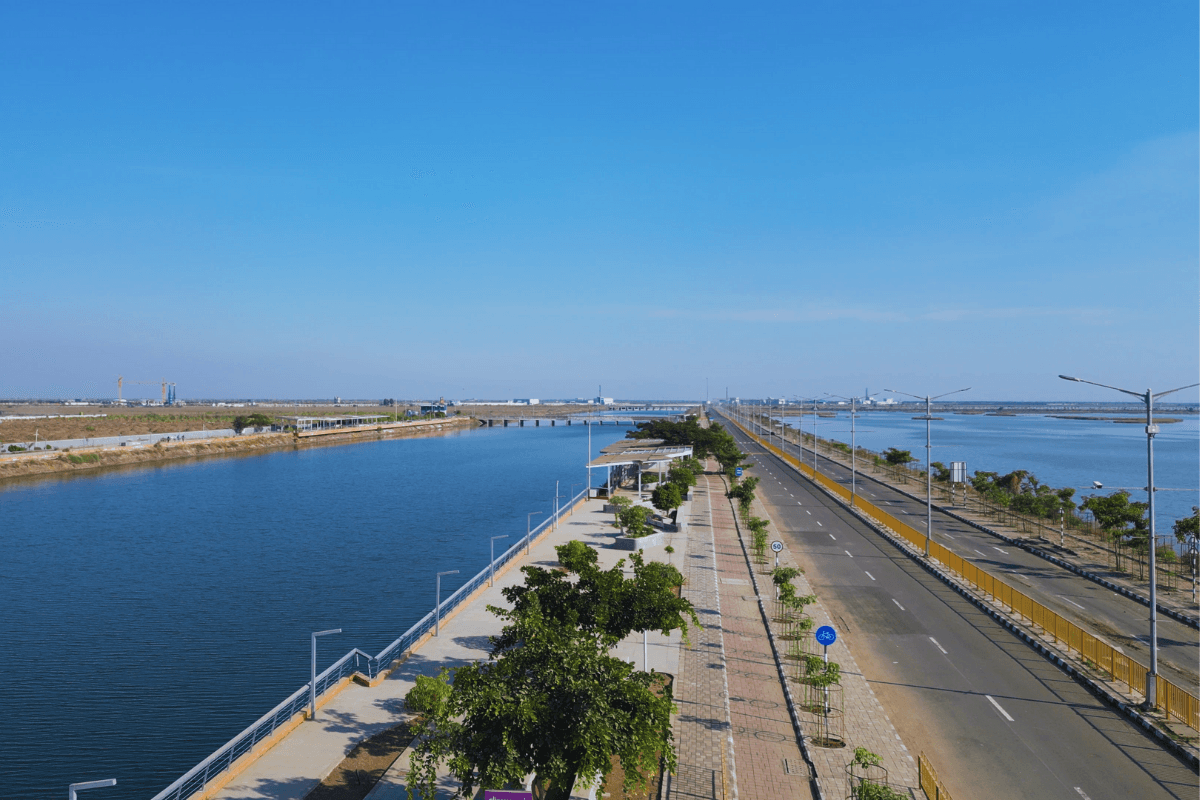
A key focus of the Dholera infrastructure plan is building essential services before large-scale urban expansion begins.
One of the most important areas currently under development is the activation area Dholera, where core infrastructure such as roads, drainage, power supply, and communication systems are already being implemented.
The Dholera activation area progress is often highlighted in Dholera Smart City latest news, as it represents the first operational zone within the larger project.
This model of plug-and-play infrastructure allows industries to begin operations quickly because utilities and transport access are already available.
Such infrastructure-first planning is considered an important step in developing modern industrial cities.
Industrial Development and Semiconductor Ecosystem
Economic activity is essential for any new city to succeed. For this reason, the Dholera SIR development strategy places strong emphasis on industrial growth.
The region is being positioned as part of India’s expanding manufacturing ecosystem through Dholera industrial corridor development.
One major development discussed recently is the proposed TATA Semiconductor plant in Dholera, which is part of a broader initiative to build a semiconductor plant in Gujarat.
If successfully implemented, the Tata Semiconductor fab could help create a wider semiconductor ecosystem in Dholera, potentially attracting electronics manufacturers, suppliers, and technology firms.
This is one reason analysts sometimes describe the region as an emerging Dholera semiconductor hub.
Connectivity Projects Supporting Regional Growth
Large infrastructure projects are also strengthening the region’s accessibility and logistics capabilities.
Dholera International Airport Development
One of the most important projects is theDholera International Airport.
Key highlights include:
- Planned to become one of the largest airports in western India
- Phase-1 construction nearing completion with runway testing expected soon
- Designed to initially handle around 12 lakh passengers annually
Improved air connectivity can play an important role in supporting international trade and industrial investment.
Ahmedabad–Dholera Expressway
Another major connectivity project is the Ahmedabad-Dholera Expressway linking Ahmedabad with Dholera Smart City.
Key highlights:
- 109-km 4-lane access-controlled greenfield corridor (NE-8)
- Expected to reduce travel time to about 45–60 minutes
- Project nearing operational readiness around early 2026
Efficient road connectivity is essential for industrial logistics, workforce mobility, and regional economic integration.
Real Estate Interest in Emerging Smart Cities
As infrastructure and industry expand, residential demand often follows.
Within the broader Dholera SIR development, interest in plots in Dholera Smart City and Dholera residential plots has gradually increased among long-term investors.
People exploring plots in Dholera generally look at infrastructure progress and city planning before making decisions.
Several companies operating as Dholera smart city developers are offering residential layouts within designated zones, including Dholera SIR plots near development areas.
However, investors typically evaluate multiple factors such as:
- Development phase
- Infrastructure proximity
- Developer credibility
However, investors typically evaluate factors such as development phase, infrastructure connectivity, and developer credibility before making a Dholera Smart City investment decision.
How Planned Cities Can Reduce Pressure on Metro Regions
India’s urban growth is gradually expanding beyond a few major metropolitan centers.
Projects like Dholera Smart City are designed to distribute economic activity across new regions rather than concentrating everything in a few crowded cities.
Two major elements support this strategy:
- Industrial corridors such as the Delhi-Mumbai Industrial Corridor encourage industries to develop outside traditional metro regions.
- Infrastructure-first development ensures that roads, utilities, and transport networks are created before large population inflows begin.
The objective is not to replace existing metro cities but to develop additional urban centers that support balanced economic growth.
Final Thoughts: A Changing Perspective on Urban Living
India’s metro cities will continue to remain important economic centers. However, rising population density and infrastructure limitations are encouraging new approaches to urban planning.
Dholera Smart City Project illustrate how future urban regions might be designed with integrated infrastructure, industrial ecosystems, and structured planning.
For investors and policymakers, the conversation is gradually shifting from only established metro markets to also considering emerging cities supported by long-term infrastructure development.
As India continues to expand its economic corridors and smart city initiatives, new urban centers may increasingly complement traditional metropolitan regions.
Frequently Asked Questions
Q. Why are buyers comparing Dholera Smart City with overcrowded metro cities?
A. Buyers compare Dholera Smart City with overcrowded metro cities because they want better long-term planning, lower congestion, and more future-focused investment options.
Q. What makes Dholera Smart City different from crowded metro cities?
A. Dholera Smart City is different because it is being developed with planned infrastructure, wider roads, industrial zones, and better long-term growth vision.
Q. Is Dholera a better long-term option than overcrowded cities for investors?
A. For many long-term investors, Dholera investment looks attractive because of planned development, improving connectivity, and future industrial growth.
Q. How does planned infrastructure in Dholera support future growth?
A. Planned infrastructure helps Dholera Smart City grow in a more structured way through better road networks, industrial development, and future-ready connectivity.
Q. Are there residential plots in Dholera for long-term buyers?
A. Yes. Buyers can explore WestWyn Residency, which offers premium residential plots in Pipariya, Dholera, suitable for long-term buyers who prefer planned development and better future growth potential.
Share With Your Friends & Family:


